
Research program
AEGIS is organized in three research layers, which match its three work packages. Together they turn scattered edge datacenters into one carbon-efficient, grid-interactive resource. Each Doctoral Candidate (DC) owns one project; the projects are grouped by layer below.
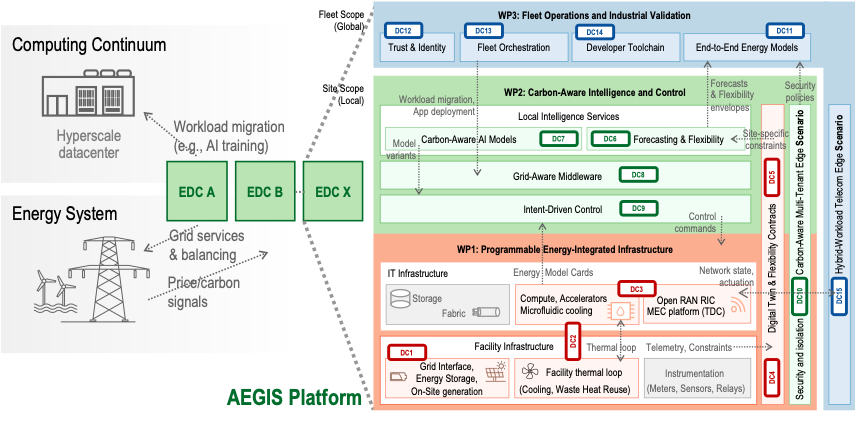
The AEGIS platform. WP1 gives safe control of a site's physical assets, WP2 adds carbon-aware intelligence, and WP3 coordinates many sites for the grid. Each box shows the Doctoral Candidate (DC) who works on it.
Layer 1 — Programmable infrastructure (WP1)
This layer gives safe, verifiable control over a site’s physical parts: power electronics, cooling, and AI hardware. It moves step by step from safety guarantees, to switching flexibility on, to a model that reports how much flexibility is available.
- DC1 — Grid Interface Control and Runtime Verification
- DC2 — Grid-Interactive Thermal Flexibility for EDCs
- DC3 — FPGA-Based AI Accelerator Options for Ultra-Low-Carbon Inference
- DC4 — Carbon-Aware Digital Twins for Flexible EDCs
Layer 2 — Carbon-aware intelligence (WP2)
This layer reads grid signals and turns high-level goals into concrete hardware and workload actions, without breaking service: forecasting, adaptable AI models, workload mobility, intent-driven control, and privacy and security.
- DC5 — Privacy-Preserving Energy Flexibility Quantification for EDCs
- DC6 — Flexibility Modeling and Forecasting for EDC Fleets
- DC7 — Carbon-Aware Neural Architecture Search (NAS)
- DC8 — Grid-Aware AI Workload Mobility for the Computing Continuum
- DC9 — Intent-Driven Power Management and Facilities Control
- DC10 — Privacy and Safety for Carbon-Aware Site-Level Workload Management
Layer 3 — Fleet orchestration (WP3)
This layer coordinates hundreds of sites into one Virtual Power Plant: end-to-end energy models, a cryptographic trust layer, fleet-level workload shaping, developer tools, and a live telecom pilot.
- DC11 — End-to-End Energy Modeling for Distributed AI Services
- DC12 — Agentic Verification for Trusted Autonomous Operations
- DC13 — Fleet-Level Workload Shaping with Live Grid Signals
- DC14 — Energy-Efficient Full-Stack Development Toolchain for Energy-Aware AI Apps
- DC15 — Responsive Telecom Edge Sites Aggregated as Virtual Power Plants
Where we test the platform
AEGIS proves its technologies in two real settings:
- A hybrid-workload telecom edge fleet, where telecom network functions and general AI workloads share the same sites.
- Carbon-aware multi-tenant edge datacenters, where several tenants share one site and security must be kept while saving carbon.